We are excited to announce the 2nd edition of the C4E Champion Award.
The C4E Champion Award is organized by C4E Forum organizers to recognize the extraordinary contribution of public officials and elected local officials in Central and Eastern Europe to progressing energy efficiency policies in their country or region. The Award is organised every two years with an award ceremony at the C4E Forum.
Key Changes in the 2025 Edition
This year, each country will have a National Champion instead of a national nominee. Among these national winners, one will be selected as the Regional Champion. National Champions will receive a fee waiver to participate in the C4E Forum 2025, covering accommodation and meals. Renovate Europe will oversee the decision-making process for selecting the National Champions.
The winners will be officially announced at the C4E Forum Award Ceremony on 21 May.
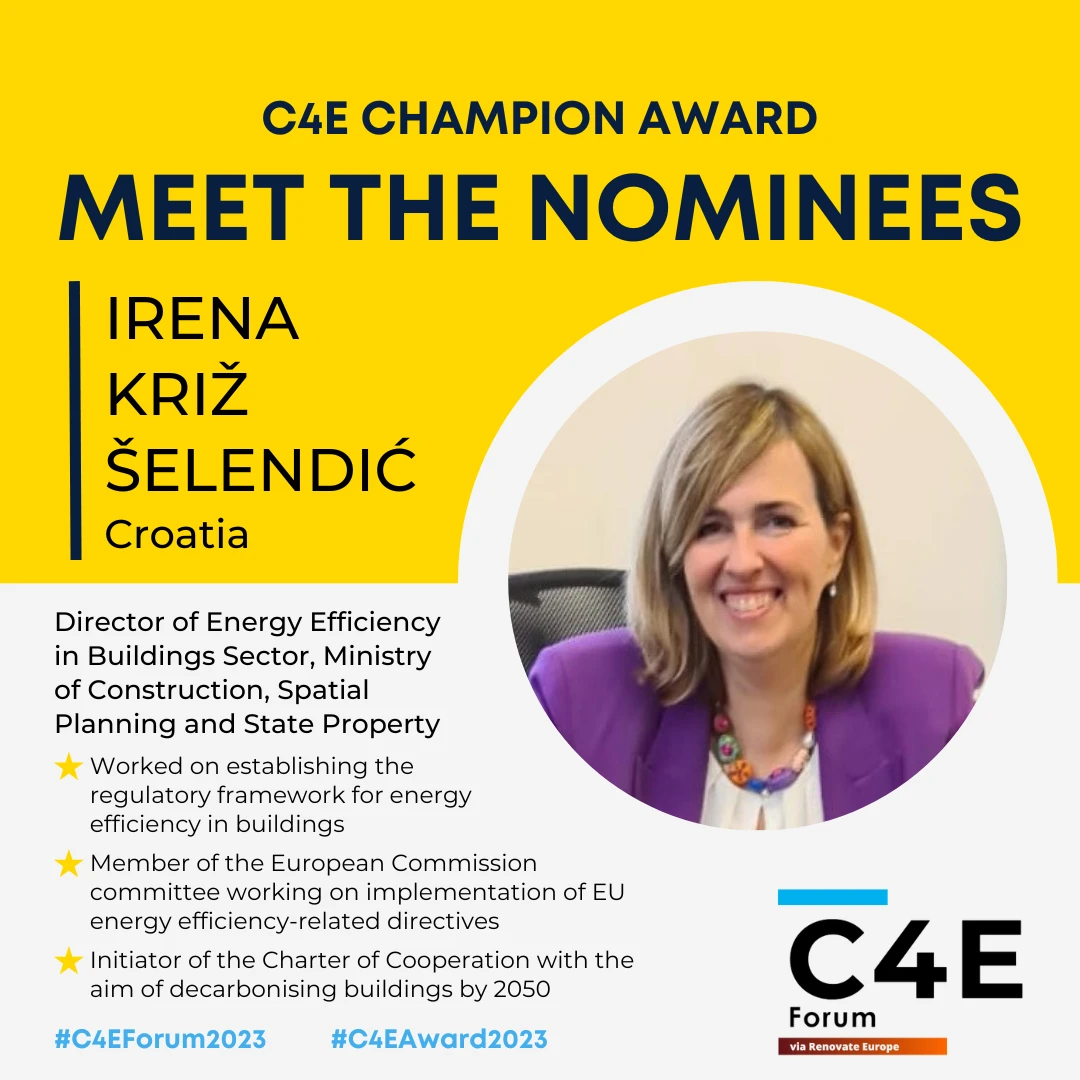
After the announcement that the C4E Forum will be held in Croatia in 2025, we asked the Croatian nominee for the C4E Champion Award 2023 about her reaction to this news and about real challenges that Croatia is facing.
A short interview with more details below:
How did you react when you found out that the C4E forum will be held in Croatia next year?
Of course, my colleagues and I, who work on building renovations, were thrilled.
We have been participating in this forum for several years, and it is certainly an honor for us to host colleagues from neighboring countries in Croatia.
It is also a kind of recognition for Croatia for everything it has done in the field of energy renovation and comprehensive renovation, which has connected earthquake recovery that increases seismic resistance with energy renovation.
Why do you think it is good that such conferences are held at the level of Central and Eastern Europe?
It is certainly good. We support and welcome such conferences.
These countries, which are members, are also neighbouring countries, they share part of a common history, have a similar way of building, similar architectural heritage, and have a lot to share. There is great potential for renovation in the countries of Central and Eastern Europe, for both public and private buildings.
There are also great challenges for all of us until 2050. It is necessary to establish new financial mechanisms so that we can renovate all buildings, and therefore the exchange of experiences and best practices from our countries is very important.
What do you think is the biggest challenge this year and next year in the construction and legislation sector? Is it MEPS or the creation of National Building Rehabilitation Plans? or both? Or something else?
We are already on a wave of renovations, and in Croatia, one of our biggest challenges in the next two years will be the lack of qualified labor, which we have already encountered. This is something we need to work on systematically, and within the framework of the National Recovery and Resilience Plan, we have several reforms addressing this issue. We are educating both domestic workers and workers from third countries, and we are also developing new study programs, so we are working on many fronts.
Additionally, in the next two years, member states will have to transpose the Directive on the Energy Performance of Buildings into their legislation, and this part will be less challenging than the implementation. Given that for the first time we have a mandatory renovation obligation that we did not have prescribed in this way, and considering that this will engage very large financial resources and a very large number of workers, it will be a huge challenge to transfer and achieve everything in the coming period. Therefore, we all need to work together. We must not lose sight of the “energy efficiency first” principle because if the renovation is reduced to some cheaper and shallow measures that are short-term profitable or just to fulfill the renovation on paper, it will be counterproductive to all our goals.
About the interviewee:
Irena Kriz-Selendic is currently Director of Sector, Energy Efficiency in Buildings in Croatian Ministry of Construction, Spatial Planning and State Property. Worked on the establishment of the entire regulatory framework for energy efficiency in buildings in Croatia, including Long term renovation strategy and on the development of national energy renovation programs for multi-apartment buildings, family houses, public sector buildings, cultural heritage buildings and energy poverty reduction programs. She participated in numerous EU projects (IPA 2012 “Strengthening Energy Efficiency in Buildings in Croatia”, Concerted Action for EPBD, Concerted Action for EED, CEI, BUILD UPON, BUILD-UP SKILLS project (COSKILLSS) and is a member of the committee at the European Commission that works on the implementation of EU directives in the field of energy efficiency. Irena received the annual award in 2019 for Person of the Year for Green construction and sustainable development, awarded by the Croatian Council for Green Construction and HUPFAS (Croatian Association of Thermal Facade Systems Manufacturers) and HUEC (Croatian Association of Energy Certifiers) for a special contribution to the promotion of green construction and sustainable development in Croatia.
It’s really all the fault of last year’s C4E event in Šamorin, Slovakia. First, the organisers more than surprised me already in the spring with a nomination for the C4E Champion 2023 award.
Apreciation leads to encouragement
Government officials are not used to being praised and singled out for their work. My job at the ministry is to take care of the system of spatial and construction legislation and the preparation of technical regulations. For an outside observer, this is not an attractive job. The results of my work are published in the official gazette of Slovenia, not in some prestigious scientific magazine, at some art event or sports venue. Regulations imply restriction and rules that wave to be obeyed, so they are not popular, even if they improve the standard of living. That’s why no one is patting us on the back. But the organisers of C4E did just that. Uau!
Among the tasks that I have been performing at the Ministry of Natural Resources and Spatial Planning for well over twenty years is the preparation of building regulations in the field of efficient use of energy in buildings. Slovenia (and formerly Yugoslavia) has a long experience with this. The first standard was prepared around 1975, and my first regulation in this area is from 2002. Since then, several were published, and each time the requirements for energy savings became more strict. What is more, the requirements that buildings must provide part of the energy themselves and that these sources must be renewable are increasingly stricter. The last, currently valid regulation is from 2022. Continuity of work on the energy efficiency of buildings and commitment to sustainable construction earned me a nomination for C4E Champion 2023. The certificate for this proudly hangs in my office.
From theory to practice
The C4E Forum in Šamorin has another, perhaps even more important side effect for me. Participating in these meetings of energy enthusiasts from Central and Eastern Europe – I was at the forums in Bulgaria and Romania – encouraged me every time to think about whether we are just talking and prescribing, or whether we are doing ourselves what we want from others. I can proudly say that during the years of work at the ministry, I have gradually updated the house I live in, built in the 1970s. We replaced all the windows, additionally insulated the facade, installed external blinds, additionally insulated the roof, switched from outdated wood-burning stove to a condensing gas boiler and introduced central ventilation with heat recovery.
Then the C4E conference in Šamorin happened! The organisers surprised us with a formal presentation of the nominees and the announcement of the awards in the extraordinary hall at Pezinok Castle. After the ceremony, I got into a conversation with a Slovenian colleague from the ministry of energy, and casually mentioned to him that we are thinking of installing photovoltaic panels on our roof one day, in five or ten years, to produce green electricity. And he answered me: “What? In five years! No way, you must put it on the roof this year, because then the connection conditions will change, and it will be less favourable!” Others who listened to us also agreed that 2023 is indeed the right year for a power plant on the roof. And I didn’t sleep well that night. When I returned home, we had a family consultation and during it I told my family that it would be wise to spend the savings on the solar panels on the roof. The family agreed, and the son immediately contacted a company that supplies and installs rooftop power plants. I was sure that the local energy company would not approve me to connect the photovoltaic device to the public electricity grid, but I was wrong, we got the approval in two weeks. Also, the installation took place a few months earlier than I was expecting. We were lucky that the chosen company could not install a power plant at a certain facility, and they were able to do it on our roof, in the middle of summer. So, the meeting in Šamorin cost me a lot of money, but we are proud owners of our own photovoltaic power plant.
Natural next steps
But this did not end the long trail of the forum in Šamorin. When I was bragging at work about my new roof acquisition, a fellow colleague who works with me wisely remarked: “Now that you generate electricity yourself, you also have to use it, so replace the gas boiler with a heat pump!” And I repeated the process again: the family council, which once again decided to dig into our pockets and invest in a heat pump that started operating in mid-October, just in time – at the beginning of the heating season.
Eko-sklad, a public fund that has been encouraging citizens, companies, and public institutions to use energy more efficiently for more than two decades, is helping financially us and others in Slovenia with both renovations. This way, I will get back part of the funds invested in the self-sufficient power plant on the roof and by switching from a gas boiler to a heat pump. But the applicants in Slovenia are so many that it will be (partly) refunded in the middle of this year.
Our house has been deeply renovated to “nearly zero energy” and we cover all our energy needs with our own environmentally friendly energy production from the roof photovoltaics. We enjoy an excellent indoor environment, with the awareness that we are doing it in a sustainable way. And the C4E forum in Šamorin is to blame for this!
February 2024
About the author:
Saša Galonja is the Head of Construction Division, Spatial Planning, Construction and Housing Directorate at the Slovenian Ministry of the Environment and Spatial Planning
The updated National Energy and Climate Plan (NECP) of Hungary covers the dimensions of decarbonisation, energy efficiency, energy security, internal energy market and research, innovation and competitiveness of the Energy Union. This writing focuses on the climate and energy efficiency aspects of the Hungarian NECP.
Hungary is particularly exposed to the unintended effects of climate change compared to the rest of Europe due to its location inside the continent and the specific microclimate of the Carpathian Basin, but in global comparison the consequences of warming are lagging behind the expected changes in other regions of the world, in particular the most vulnerable developing regions.
Hungary remains committed to achieving long-term climate target, that is, becoming climate neutral by 2050. We want to achieve our energy independence through demand reduction and energy efficiency, diversification and alternative energy sources utilisation and electro-electrification measures. Increasing energy efficiency is our priority by using renewable-based heating/cooling solutions, reducing the share of natural gas in the district heating sector and reducing energy use for residential, public, industrial and transport purposes.
The Hungarian NECP states that the Hungarian Government must pursue a realistic and responsible policy in the field of climate protection. It should be realistic in terms of the expected results of interventions under current technologies and their cost implications. This is in line with the energy mix and climate targets of Central and Eastern European countries. The European Union expects its member countries to have an overall climate-neutral economy by 2050. In the period up to 2035, the extra investment cost of the WAM (With Additional Measures) scenario is in the order of HUF 500 billion per year. On the other hand, investments reduce operating and carbon quota costs. Thus, the annual net additional financing needs are HUF 155 billion. In the view of the Hungarian Government, this objective is achievable for Hungary, but this requires a substantial financial contribution from the European Union. The objectives of economic growth and climate protection are not at odds. Hungary is among the 21 countries in the world where gross domestic product has increased since 1990, while CO2 emissions have fallen by 37% and energy use by 15%. Thus, Hungary is not only at the forefront of economic growth, where the gross domestic product growth exceeds the average GDP growth in the euro area by 2−3 percentage points, but also has an exemplary practice in the field of climate protection.
Hungary is a member of the Visegrad Cooperation and the Central and South-Eastern Europe High Level Group on Energy Connectivity (CESEC), where energy and climate policy issues relevant to the NECP are regularly discussed. The regional consultation on Member States’ Energy and Climate Plans was held in Bratislava on 23 April 2023 with the participation of Czechia, Hungary, Poland and Slovakia. The meeting provided an opportunity to discuss the progress of individual Member States in the preparation of the revised NECPs at regional level, to learn about their draft plans.
With regard to the NECP, the Hungarian Government authorised the Hungarian Ministry of Energy to meet the objectives of the Energy Union and to comply with the Paris Agreement. The ministry is to develop appropriate policy programmes and visions for issues that require a political decision on the future of the energy sector and other sectors affected by decarbonisation; setting national targets and domestic contributions on energy and climate change, in particular emissions reduction, energy efficiency and increasing the share of renewable energy.
Hungary aims to reduce its gross greenhouse gas emissions by at least 50% by 2030 compared to 1990, i.e. gross emissions should not exceed 56.19 million t CO2eq gross in 2030, i.e. a reduction of 7.6 million t CO2eq compared to 2017. Our main energy efficiency target is that the country’s final energy consumption in 2030 does not exceed 750 PJ. This also means reducing our final energy consumption by around 6% by 2030 compared to 2021 (802 PJ). We also set a target of 336 PJ of cumulative final energy savings by 2030 – a new saving of 61 PJ over 10 years. 3% of the floor area of central government buildings will also be renovated each year to the optimal level of cost.
In line with our EU obligations, in 2021 the Government adopted the Long-Term Renovation Strategy (HTFS), which provides the basis for achieving a sustainable, energy and cost-effective domestic building stock by 2050 through energy efficiency, value, comfort and health promotion measures, renewable energy use and the use of smart technologies. The strategy aims to achieve a 20% saving in the energy use of the domestic residential building stock by 2030, a 60% reduction in CO2 remissions related to the energy use of buildings by 2040 compared to the 2018-2020 average, and nearly zero-energy buildings to reach 90% by 2050. With the modernisation of the residential building stock to improve energy efficiency and the shift to alternative heating methods, we estimate that up to a quarter of natural gas imports (around ~2 billion m3 natural gas use per year) could be replaced. The aim is also to further improve the final energy intensity of GDP, which will fall below HUF 0.429 toe/million by 2030, while maintaining economic growth.
In order to achieve the energy efficiency targets in a cost-effective manner, we have put in place an energy efficiency obligation scheme (EEOS) to channel investments on a market-based basis to those areas with the highest energy use and energy efficiency potential. Improving the energy efficiency of the economy is one of the priority projects of the new Energy Strategy. The contribution of the EEOS to the national energy savings target is 26%. Alternative energy efficiency policies should account for 74% of the target. Therefore, we consider it of utmost importance to continue and renew alternative policy measures to improve energy efficiency. In the case of central budget and local government investments in building energy and energy efficiency, ESCO-based services can reduce the use of budgetary resources and EU grants, thus contributing to the reduction of public debt and a more rational use of subsidies that will decrease in the 2021-27 programming period.
Author:
Amb. dr. Barbara Botos, Ambassador-at-large for Climate, Ministry of Energy, Hungary
About the author:
Dr Barbara Botos was appointed as Hungary’s Ambassador at Large for Climate in 2022. Prior to her new appointment, Barbara Botos was the Deputy Secretary of State for Climate Policy at the Ministry of Innovation and Technology of Hungary for four years, where she was in charge of international, EU and national climate change, renewable and energy efficiency policy-making and programs. Previously, she was Head of the Department of Climate Policy at the Ministry of National Development. She has been actively involved in the UNFCCC and EU climate negotiations for the last 11 years as head of the Hungarian delegation and UNFCCC and IPCC focal point of Hungary. Previously, Barbara was teaching at universities and worked for local governments in the field of environmental protection and climate policy. She is a member of the Women in Energy Association.
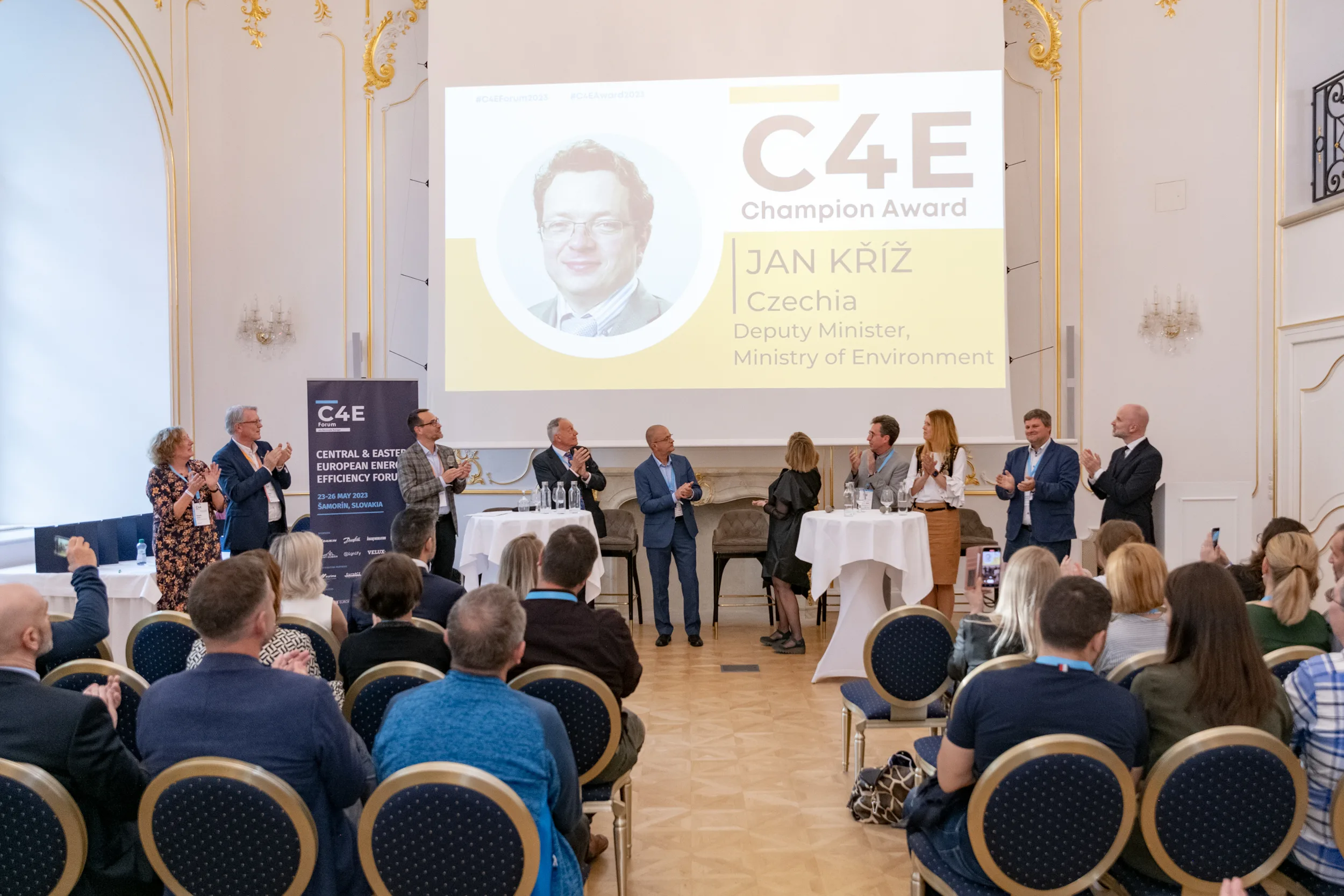
Jan Kříž, Deputy Minister at the Ministry of Environment of the Czech Republic, was awarded the first edition of the C4E Champion Award in a festive ceremony that took place last evening at the Šimák Castle in Pezinok, Slovakia.
The C4E Champion Award is an initiative launched by the C4E Forum, which is currently holding its fourth edition in Šamorín, Slovakia. The purpose of the award is recognising the role of public officials in enhancing energy efficiency of buildings in Central and Eastern Europe (CEE).
Being responsible for 36% of the EU’s CO2 emissions and 40% of our energy consumption, buildings play a key role in tackling the current energy and climate crisis. Therefore, strong leadership in the public sector becomes essential in the implementation and promotion of good practices in the transition to a fully energy efficient building stock.
A total of 7 officials from different countries in the CEE region were nominated,
“It is a pleasure seeing so many CEE public officials leading in the push for more ambitious renovation and energy efficiency policies in their countries,”
says Adrian Joyce, Director of the Renovate Europe Campaign and member of the award’s jury.
“It is our duty to acknowledge their pioneering work and to hope that many more officials follow the footsteps of our nominees. They have proven their will to engage with stakeholders and have displayed strong conviction to further profiling energy efficiency and renovation as a political priority,”
he added.
The jury selected Jan Kříž as the first awardee of the C4E Champion Award in appreciation of his long-term work on renovation support projects in the Czech Republic.
“Mr. Kříž’s greatest achievement has not only been his contribution to establishing exemplary programmes such as the single-family home renovation subsidy program Nová zelená úsporam, but especially his strong defence of quality renovation for more than 10 years over several political cycles and pressures,”
says Renée Bruel, Director of Buildings Programme at the European Climate Foundation and also member of the jury.
“Thank you very much for the appreciation that I have received from your side. It’s a very big motivation for us and for our team that is engaged in energy efficiency projects,”
“small innovation every year rather than deep changes is the reason behind the success of our programmes.”
The fourth edition of the C4E Forum is taking place from 23rd to the 26th of May in Šamorín, Slovakia. With the presence of around 240 participants representing all sectors (government, industry, research, and not-for-profit), the C4E Forum has established itself as the premier biennial event on energy efficiency policy in Central and Eastern Europe.
You can follow the latest news on the activities of the C4E Forum by following its specific pages on Twitter and LinkedIn, and by visiting its website.